
Why Garage Door Springs Break in Winter
Cold snaps get blamed for broken garage door springs, but the real story is metal fatigue that winter just happens to finish. Here's what's actually going on, and what to watch for before your spring lets go on a January morning.
Cold Metal Behaves Differently Than Warm Metal
Every winter our phone starts ringing more on the mornings after the temperature drops hard overnight, and almost every one of those calls is the same story: the homeowner tried to leave for work, hit the opener button, and heard a bang like a gunshot instead of the usual hum of the door lifting. Nine times out of ten, that bang was a torsion spring letting go.
There's a reason this happens so much more in January than in July. Steel contracts as it gets colder, and that contraction is not perfectly uniform across a coiled spring. The tightly wound coils of a torsion spring already carry enormous stored tension even at rest — that's the whole point of the design, since the spring's job is to counterbalance the weight of the door. When the metal contracts in the cold, the coils tighten slightly further and the stress at the most worn point of the coil goes up. Cold steel is also somewhat less ductile than warm steel, meaning it has a little less give before a crack propagates through it. Neither of these effects is dramatic on its own. But a spring that's already near the end of its service life doesn't need a dramatic push — it needs a small one, at exactly the wrong moment.
It's Rarely Just the Cold — It's the Cold Finishing a Job Wear Already Started
This is the part that surprises most homeowners: a garage door spring doesn't fail because of one cold morning. It fails because it has been wound and unwound thousands of times over years of daily use, and metal fatigue builds invisibly with every cycle long before any crack is visible to the eye. Manufacturers rate springs by cycle life — the number of full open-and-close cycles a spring is engineered to handle before failure becomes statistically likely — and standard-duty torsion springs are typically built toward the lower end of that range, with higher-cycle springs available for doors that get opened and closed many times a day. A door that gets used twice a day, every day, for eight or nine years, has gone through a lot of those cycles.
Cold weather doesn't create that fatigue. It just happens to be the environmental condition present when a spring that was already close to its limit finally gives out. That's why so many failures cluster in December, January, and February around here — not because winter is uniquely destructive to springs in some mysterious way, but because the springs installed years ago are aging at the same time the coldest stress of the year shows up and asks the metal to do just a little more than it has left to give.
Torsion Springs vs. Extension Springs in a Peoria Winter
Most garage doors around Peoria use one of two spring systems, and they don't handle cold weather identically. Torsion springs mount horizontally above the door on a metal shaft and twist to store energy — they're the more common setup on newer installations and larger doors because they distribute force evenly and tend to be more durable overall. Extension springs run along the horizontal tracks on either side of the door and stretch to store energy instead of twisting. Older homes in neighborhoods like West Bluff, where a lot of the housing stock predates modern torsion-spring standards, are more likely to still have an extension-spring setup, sometimes without the safety containment cables that current standards call for.
Both systems are vulnerable to cold-weather failure through the same fatigue-plus-contraction mechanism described above, but extension springs that lack containment cables are the more dangerous of the two if they do let go, since a broken extension spring under tension can become a projectile rather than just falling in place along the track. If you're not sure which type is on your door, or whether your extension springs have safety cables, our breakdown of torsion vs. extension springs covers how to tell them apart and why the distinction matters for winter safety specifically.
The Physics of a 20-Degree Morning
Picture a typical sectional garage door — a couple hundred pounds of wood or insulated steel panels, hardware, and glass if there are windows in it. That door isn't lifted by the opener motor at all; the opener just provides a small amount of force to start and guide the motion. The actual lifting work is done by the spring, which is wound tight enough at installation to counterbalance nearly the full weight of the door. That's a lot of stored energy sitting in a coil of steel bolted above your head.
On a 20-degree morning, that coil is slightly more contracted, slightly less forgiving, and being asked to do the same job it's always done — except now it's doing that job at the exact moment its accumulated fatigue crosses a threshold it's been approaching for years. The spring doesn't know it's cold outside. It just reaches the point where the smallest additional stress, whatever that stress happens to be that morning, is enough to finish a crack that's been growing invisibly along the coil for a long time.
Signs Your Springs Are Under Extra Strain This Winter
Springs rarely fail with zero warning. Most give off signals in the weeks or months before they finally let go, and cold weather tends to make those signals more obvious. Watch for:
- The door feels noticeably heavier when you lift it manually (with the opener disconnected) — a properly balanced door should lift with one hand and stay roughly in place partway up.
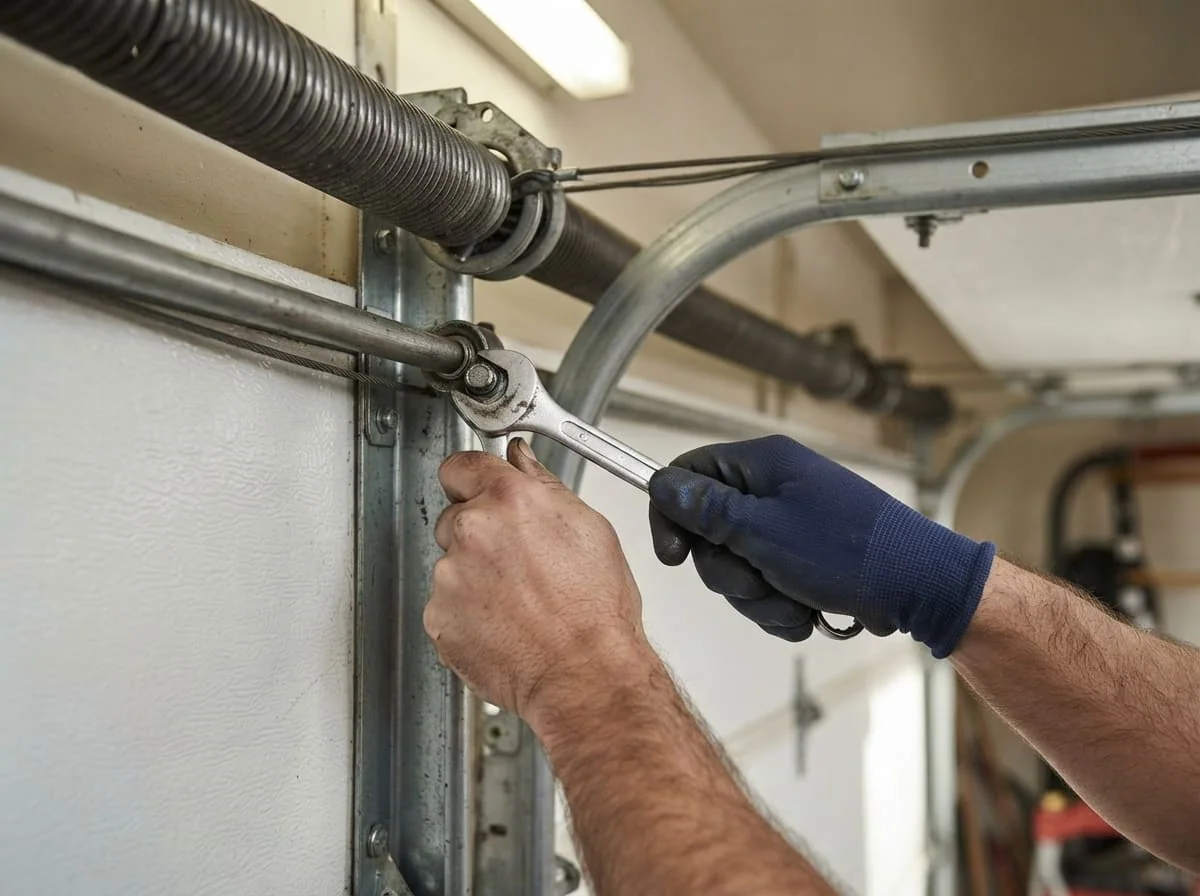
- Visible gaps between coils on the torsion spring, where the coils used to sit flush against each other.
- A loud pop or bang from the garage at some point when nobody was actively using the door — this is sometimes an early partial failure, not the final break.
- The opener straining audibly or the door moving in jerky, uneven motions instead of smooth travel.
- Visible rust concentrated on the spring itself, which accelerates fatigue and is common in garages that see road salt and slush tracked in all winter.
- The door slamming down faster than normal near the bottom of its travel, a sign the spring is no longer offsetting the door's weight the way it should.
Any one of these is worth a call before the spring finishes the job on its own timetable instead of yours.
What Happens the Moment a Spring Lets Go
A torsion spring failure is loud and sudden — the bang homeowners describe is the coil releasing all of its stored tension at once. If the door was up when it happened, it will typically come crashing down immediately, since nothing is left counterbalancing its weight; the opener alone cannot hold a door up against gravity. If the door was down, you'll usually just hear the bang and then discover, on your next attempt to open it, that the door has become extremely heavy or won't move at all. In either case, the shaft and cable drums are no longer under controlled tension, which is exactly why cables can jump their drums or fray in the same incident.
This is also why garage door springs are treated as a genuine safety component rather than a simple wear part. Industry testing standards published by the Door and Access Systems Manufacturers Association address exactly this kind of stored-energy failure, and the U.S. Consumer Product Safety Commission has documented garage door springs as a recurring source of home injuries when people attempt to service them without the right tools or training. A spring under full tension has enough stored force to cause serious injury if it releases while someone's hands or face are near it, which is the single biggest reason we tell homeowners not to attempt this repair themselves.
Preventive Steps That Actually Help Before the Next Cold Snap
You can't stop metal fatigue entirely, but you can slow it down and catch a failing spring before it becomes a Saturday-morning emergency. A few habits make a real difference heading into winter:
- Lubricate the springs with a silicone-based or garage-door-specific lubricant (not household oil, which attracts grit) once or twice a year, ideally before the first hard freeze.
- Do a manual balance check by disconnecting the opener and lifting the door by hand — it should move smoothly and hold its position roughly halfway open. If it doesn't, the spring tension needs adjusting by a technician, not a homeowner with pliers.
- Look at the coils monthly during winter for gaps, rust, or visible stretching.
- Keep the garage itself a bit warmer if you can — an insulated door and a sealed garage won't stop fatigue, but they reduce the temperature swing the spring experiences and cut down on condensation-driven rust.
- Track how old the springs are. If nobody's replaced them since the house was built or since your last opener upgrade, and that was close to a decade ago, that alone is worth a conversation.
Our full garage door maintenance checklist goes through the rest of the door's hardware — rollers, tracks, hinges, and cables — that tend to wear alongside the springs and are worth checking at the same time.
Why This Matters More Here Than in Milder Climates
Peoria sits in a humid continental climate zone, which means our winters bring real cold, an average of roughly 26 inches of snow a year, and a lot of freeze-thaw cycling as temperatures swing above and below freezing over the course of a week. That freeze-thaw pattern is harder on garage hardware generally than a climate that just gets steadily cold and stays there, because the expansion and contraction happens repeatedly rather than once. Add in road salt and slush getting tracked into garages all season, which accelerates surface rust on springs and cables, and you've got a genuinely tougher environment for this hardware than what a spring is tested under in a lab at a stable temperature.
We see this pattern across the whole service area, not just in one part of town — older housing stock in Downtown Peoria and West Bluff with original hardware, newer builds out in the growing suburbs that are just now hitting the age where factory-installed springs start to wear out, and everything in between. The mechanism is the same everywhere; it's just a matter of which houses have springs that are closest to their limit when the next cold snap arrives.
When to Call for Spring Replacement vs. When It's Something Else
Not every winter garage door problem is a spring. A door that won't respond to the opener at all might be a sensor or electrical issue rather than a spring failure — that's a separate troubleshooting path entirely. But if you've heard the bang, if the door has suddenly become too heavy to lift by hand, or if you can see a visible gap in the spring's coil, that's a spring, and it's not a repair to attempt without the right bars, gauges, and experience — the stored tension involved is exactly the kind of thing the safety standards referenced above exist to warn people about.
Our crew, including Danny and Ray both, handles broken spring repair and replacement as a routine part of the work we do year-round, and winter is genuinely our busiest season for it. If your spring goes on a morning you need the car out of the garage, we treat that with the urgency it deserves — see our same-day repair service for how that works. For anything less urgent, or if you just want a second opinion on whether your springs are close to the end of their life before winter really sets in, give us a call at (309) 306-4121 and we'll take a look, or read more about our shop on Main Street.

Danny Kowalski
Owner and lead technician at Peoria Garage Door Repair Guys, serving Peoria, IL since 2015.
FAQs
Can I replace a broken garage door spring myself?
We don't recommend it. A torsion spring holds enough stored tension to cause serious injury if it's mishandled, and the job requires winding bars and tension gauges most homeowners don't have on hand. This is one of the few garage door repairs where the safety math genuinely favors calling a technician rather than tackling it as a weekend project.
How long do garage door springs typically last?
It depends heavily on how many times a day the door cycles rather than on calendar time alone. Springs are rated by DASMA-referenced cycle-life standards rather than a fixed number of years, so a door that opens and closes many times a day will wear out its springs faster than one used once or twice daily, even if both doors are the same age.
Why did my spring break on the coldest morning of the year specifically?
Cold weather doesn't cause the underlying fatigue, but contracted, less-forgiving steel needs less additional stress to finish a crack that's already been developing for years. Cold mornings just happen to be when a spring nearing the end of its life is most likely to finally give out.
Is a broken spring an emergency?
It depends on your situation. A broken spring makes the door too heavy to lift safely by hand and unsafe to operate with the opener, so if you need the car out of the garage right away, it functions like an emergency. We treat same-day spring calls as a priority, especially in winter when they're most common.
Can I still open my garage door manually if the spring breaks?
Technically you can pull the emergency release cord, but without spring tension a standard door can weigh far more than one person should lift, and it can drop suddenly once released. We generally advise leaving the door closed and calling for repair rather than forcing it open manually.
Does keeping the garage warmer prevent spring breakage?
It helps at the margins by reducing the temperature swing the spring experiences and cutting down on rust from condensation, but it won't stop metal fatigue from accumulating over years of normal use. A warmer garage buys you a little cushion; it doesn't replace a spring that's already near the end of its service life.
Have a Garage Door Problem Right Now?
Skip the guesswork — call Peoria Garage Door Repair Guys for a fast, honest diagnosis.