Commercial Garage Door Repair in Peoria, IL
A stuck bay door doesn't just sit on a punch list — it stops trucks, blocks docks, and costs you production time. We get commercial doors moving again fast.
- Locally owned since 2015
- Insured, background-checked techs
- Free upfront quotes
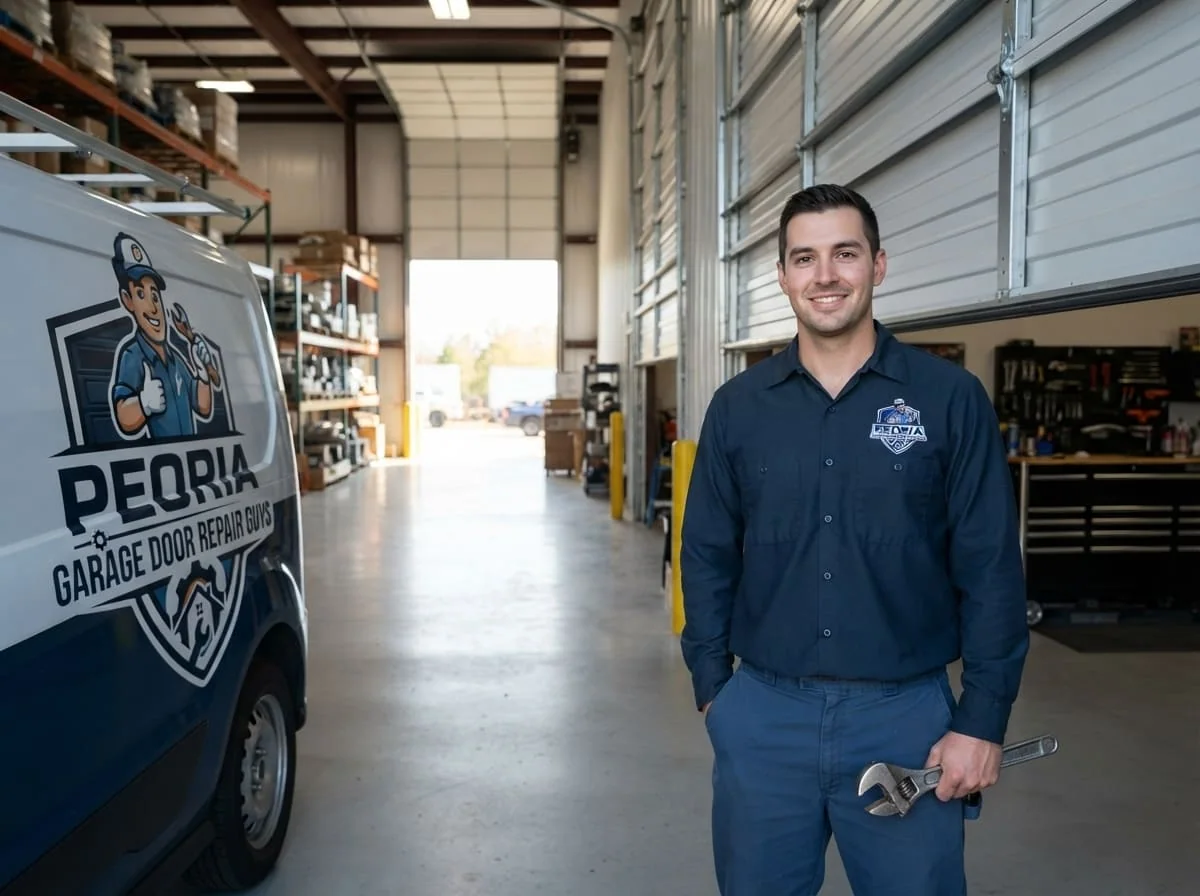
Commercial overhead doors take a different kind of beating than a homeowner's garage door. A sectional door on a distribution warehouse or a rolling steel door on a shop bay might cycle dozens of times a day, get clipped by a forklift, or sit exposed to road salt and exhaust all winter. When one of those doors jams half-open or won't seal against the weather, it's rarely a simple fix — and it's rarely something that can wait.
Peoria Garage Door Repair Guys works on the heavier-duty hardware that commercial and industrial buildings actually use: high-cycle torsion springs rated for repeated daily use, reinforced tracks, chain-drive and jackshaft openers built for wider or heavier doors, and rolling steel or sectional steel doors sized for loading docks and equipment bays. We understand that a facility manager calling about a stuck bay door isn't looking for a sales pitch — they need someone who can diagnose the actual problem, quote it honestly with no surprise charges, and get the door back in service without dragging the job out.
This work comes up constantly around Peoria's industrial corridors — the manufacturing and fabrication shops near the East Peoria industrial zone, the warehouse and distribution buildings around the Peoria Warehouse Historic District downtown, and the light-industrial and commercial strips scattered through the wider Tri-County Area. A lot of that comes from the region's long manufacturing heritage; Danny grew up around it firsthand — his dad worked at one of the riverfront manufacturing plants — and it shaped how our crew approaches this kind of call: get there, diagnose it right, and don't overcomplicate the fix.
Signs Your Commercial Door Needs a Repair Call
Commercial doors tend to give warning signs before they fail completely, but because they're used so heavily, those signs get ignored or chalked up to "normal wear" longer than they should. A few patterns we see repeatedly on service calls:
- The door hesitates, reverses, or struggles partway through its cycle instead of moving smoothly open-to-close
- Visible sag, bowing, or a track that's been knocked out of alignment — often from a forklift, pallet jack, or delivery truck making contact
- Grinding, popping, or a loud bang from the spring area, especially on doors that cycle many times a day
- The door won't seal tight at the bottom, letting in cold air, pests, or water at the threshold
- An opener that's straining, cycling slower than it used to, or tripping a breaker
- Cables that look frayed or a drum that looks like it's unwinding unevenly
Any one of these on a door that's central to your loading, staging, or shop-floor operation is worth a call before it turns into a door that won't move at all.
How We Diagnose and Repair Commercial Overhead Doors
Commercial doors are bigger, heavier, and under more spring tension than a standard residential door, so the diagnostic process is more involved. We start by running the door through a full cycle to see exactly where it binds, hesitates, or loses alignment, then check the track plumb, the spring tension and cable condition, and the opener's drive mechanism — chain, belt, or jackshaft depending on what's installed.
Because these doors are often integrated with dock levelers, safety edges, or building access systems, we're careful to check how the repair affects the rest of that setup rather than treating the door as an isolated component. Once we've isolated the actual failure point, we walk you through what needs to happen and give you a straight, no-surprise-pricing quote before any work starts — not after.
For high-cycle commercial springs, track sections, and cable assemblies, we carry the reinforced hardware built for that level of daily use rather than swapping in residential-grade parts that won't hold up to the cycle count.
Why Commercial Door Repairs Aren't a DIY or Maintenance-Staff Job
A wound torsion spring on a commercial door stores a serious amount of energy — more than the springs on a typical residential garage door — and an improperly released or over-tensioned spring can cause real injury. Facilities staff are often asked to "just take a look" at a stuck bay door, but without the right bars, clamps, and experience with commercial-scale hardware, that's a dangerous ask to make of someone whose actual job is running the building.
There's also a liability angle that's specific to commercial property: an overhead door that fails to close properly, doesn't seal correctly, or has a safety reversal system that's out of adjustment can become a code or insurance issue, not just an inconvenience. Getting it diagnosed and repaired correctly the first time matters more here than it does on a house.
Peoria's Industrial and Warehouse Environment
Peoria's commercial and industrial building stock reflects the area's manufacturing history — from the fabrication and machining shops clustered near the East Peoria industrial zone across the river, to the older brick warehouse buildings downtown that make up the Peoria Warehouse Historic District, many now repurposed for commercial and light-industrial use. Caterpillar's manufacturing presence remains a major part of the regional economy even after the company's headquarters moved out of state, and that industrial base means a steady population of loading docks, equipment bays, and shop doors that see heavy daily use.
Central Illinois winters add their own stress to that equation. Road salt tracked in from I-74 and Route 150 corridors accelerates corrosion on tracks and hardware, freeze-thaw cycles work at hinges and rollers, and a door that doesn't seal tight at the bottom turns into a real heat-loss and pest-entry problem on a building that's heated and cooled all day. We size repairs — and recommend hardware — with that climate in mind, not with a one-size-fits-all approach borrowed from a milder region.
Why Businesses Around Peoria Call Our Crew
We started this company in 2015 because Danny and Ray were tired of watching a Chicago-based employer treat the Peoria market as an afterthought — routes padded with far-flung stops, and a business here waiting days for a callback that would've been same-day somewhere the company actually prioritized. Our crew answers our own phone and shows up when we say we will, which matters even more for a business trying to keep a dock or bay door in service than it does for a homeowner.
We're straightforward about what a repair actually needs, we don't push unnecessary replacement when a repair will genuinely hold up, and every technician who shows up is insured and background-checked. For a facility manager who needs a door fixed correctly and doesn't have time to manage a vendor relationship, that's the whole pitch.
What to Expect When You Call
Call and describe the problem
Tell us what the door is doing, how it's used, and how urgent it is so we can prioritize the visit and bring the right hardware.
On-site diagnostic
A technician runs the door through its cycle, checks springs, tracks, cables, and the opener to isolate the actual failure point.
Free upfront quote
We explain what's wrong in plain language and quote the repair before any work begins, with no-surprise pricing.
Repair and function test
We complete the repair using commercial-grade parts sized for the door's cycle count, then run a full open-close cycle to confirm it's balanced and sealing correctly.
Maintenance recommendation
For doors that cycle heavily, we'll flag any other wear points worth watching so a small issue doesn't turn into an unplanned shutdown later.
Commercial Garage Door Repair in Peoria, IL FAQs
Do you work on rolling steel doors as well as sectional commercial doors?
Yes, we repair both rolling steel doors and sectional steel commercial doors, along with the heavier-duty tracks, springs, and openers that go with them.
Can you repair a door that's used for a loading dock with dozens of cycles a day?
Yes — high-cycle commercial doors are exactly what our commercial hardware is built for, and we size springs and track components for that level of daily use rather than using residential-grade parts.
How fast can you get to a commercial property?
Response time depends on scheduling and where you're located in the Tri-County Area, but we treat a stuck or unsafe commercial door as a priority call and will give you an honest timeframe when you call rather than an inflated promise.
What does a commercial door repair cost?
It depends entirely on what's actually wrong — a spring, cable, track, or opener repair all price out differently. We give a free upfront quote once a technician has diagnosed the problem, with no hidden add-ons.
Is it dangerous for our maintenance staff to try to fix a stuck commercial door themselves?
It can be. Commercial torsion springs store a significant amount of energy, and working on them without the right tools and training is a real injury risk — this is a call worth making rather than a DIY project for facilities staff.
Do commercial doors need different maintenance than a residential garage door?
Generally yes, because of the cycle count involved. A door that opens and closes dozens of times a day wears hardware faster than a residential door that cycles once or twice, so we'll usually flag a shorter inspection interval for high-use commercial doors.
Can you repair a door that's out of alignment from a forklift or truck impact?
In many cases, yes — track and panel damage from equipment contact is a common commercial repair call. We'll assess whether the track and panels can be straightened and repaired or whether a section needs replacing.
Need Commercial Garage Doors in Peoria, IL?
Peoria Garage Door Repair Guys is ready to help — call now for a free, upfront quote.