
Garage Door Won't Close: A Diagnostic Walkthrough
Motor runs, door drops a foot, then reverses? Danny Kowalski walks through the real reasons a garage door won't close—in the order our crew actually checks them—before you call for repair.
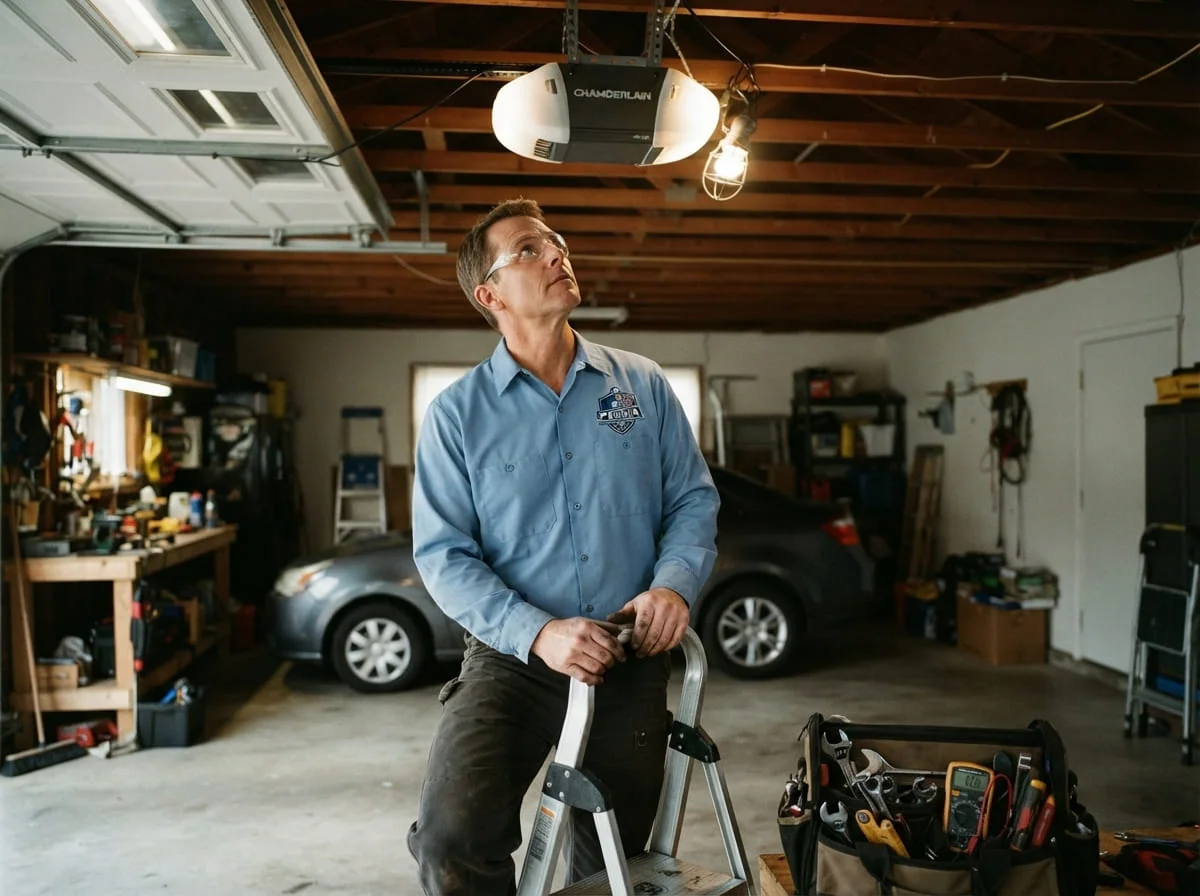
Why 'Won't Close' Is a Different Problem Than 'Won't Open'
When a garage door won't open, the cause is usually obvious from the driveway—a spring has let go with a bang overnight, or a cable has frayed through, and the door simply doesn't have the muscle to lift. A door that won't close is a different kind of problem, and it trips people up more, because the motor runs, the door usually moves, and then something stops it. It drops a foot and reverses. It gets three-quarters of the way down and hangs there making a grinding noise. It won't even start the down cycle when you press the button, even though it opened fine five minutes earlier.
Here's what trips most homeowners up: none of that is really a malfunction in the sense of something being broken. Every opener sold in the United States since 1993 has been required to include entrapment-protection features—a photo-eye sensor pair and a force-sensing reversal system—specifically so the door refuses to close on something, or someone, in its path. When your door won't close, in probably eight or nine calls out of ten, the opener is doing exactly what it's engineered to do. It's telling you something is interrupting the beam, binding the track, or tripping the force limit. The rest of this walkthrough goes through those causes roughly in the order our crew checks them on a service call, cheapest and easiest first.
Start With the Safety Sensors
Look at the bottom of your vertical tracks, about four to six inches off the garage floor, on both sides of the door. You'll see two small boxes—often plastic, sometimes metal-cased on older installs—mounted facing each other. These are the safety sensors, and they work by throwing an invisible infrared beam across the opening. Break that beam while the door is closing and the opener reverses immediately. If the beam is already broken, or badly misaligned, when you press the button, a lot of openers won't even start the closing cycle—the door just sits there.
Misalignment is, by a wide margin, the most common reason a garage door won't close. A stray soccer ball, a bike leaned against the wall, a shop-vac hose dragged across the garage floor—any of these can nudge a sensor bracket out of true by a few degrees, which is all it takes. Check both sensors for:
- Indicator lights that don't match—most units show a steady light on both sensors when aligned, and a blinking or dark light on one side when they're not
- Dust, cobwebs, or lawn clippings across the lens, which is a genuinely common problem in a garage that shares space with a mower
- Direct morning or evening sun hitting the receiver lens, which can wash out the beam the same way headlights wash out a photo
- A loose low-voltage wire at the back of the sensor housing—these are usually held with a small screw terminal that works loose over years of door cycles
This requirement isn't a manufacturer preference; it's federal. The Consumer Product Safety Commission has required non-contact entrapment protection on residential openers since 1993, and DASMA's technical documentation lays out how these systems are engineered to fail safe rather than fail closed. For the deeper engineering explanation, DASMA TDS 190 is a decent read. For our purposes, the practical takeaway is simpler: wipe both lenses with a soft cloth, nudge the brackets until the indicator lights match, and try the door again before assuming anything is actually broken.
Check the Track for Obstructions or Damage
If the sensors check out, walk the full length of both tracks—vertical and horizontal—with the door open. You're looking for anything that would stop a roller mid-travel: a dented section from a car bumper or a ladder leaned in the wrong spot, a bracket that's worked loose from the framing, or something as simple as a storage bin that's crept a few inches too close to the rail. Any of these can cause the door to bind at the exact same spot every time, which the opener reads as resistance and reverses to protect against.
Pay attention to where in the cycle the door stops. A hitch right near the top usually points to the horizontal track or the transition into the curved section. A stop three-quarters of the way down often means the rollers are hitting a bowed section lower on the vertical track—sometimes visible as a track that's pulled slightly away from the wall on one side. If the whole door has come off the track entirely rather than just binding, stop trying the opener altogether. Running a motor against a door that's derailed can bend the track further or snap a cable under uneven load. That's an off-track situation, and it's worth a same-day service call rather than a driveway fix.
Cold-Weather Culprits: What Peoria Winters Do to a Closing Cycle
Peoria sits solidly in humid continental climate territory—cold, snowy winters (the area averages around 26 inches of snow a year) with plenty of freeze-thaw swings in between—and that combination does specific things to a closing garage door that milder climates rarely see. Grease and lubricant in the roller bearings and hinges thickens in single-digit temperatures, which adds just enough drag to push an opener over its force-reversal threshold partway through the cycle. The door isn't hitting an obstruction; it's fighting stiffened hardware, and the opener correctly reads that as resistance.
Ice is the other big one. Snowmelt that drips off the door during the day and refreezes overnight can build up along the bottom of the track or on the roller itself, changing its effective diameter just enough to bind. And after a freezing rain or a hard melt-refreeze cycle—the kind the National Weather Service's Lincoln, IL office tracks for the whole Central Illinois forecast area—check the bottom weatherstrip before doing anything else. It's common for that rubber seal to bond to a wet concrete apron overnight, and forcing a frozen seal with repeated button presses is a fast way to burn out a drive gear or overheat the opener's motor. Break the seal loose by hand first, or run a hair dryer along it for a minute, rather than leaning on the wall button.
Opener Force and Limit Settings
Every opener has two related settings that control the close cycle: limit settings, which tell the motor how far the door should travel before it's considered fully closed, and force settings, which tell it how much resistance to tolerate before treating that resistance as an obstruction and reversing. Both drift over time—a door that swells slightly with humidity, a torsion spring that's lost a little tension as it ages, even a chain or belt that's stretched a few millimeters—and the opener starts reversing a foot or so before the floor even though nothing is actually in the way.
Older units adjust this with small dial screws on the motor housing; newer models bury it in a wall-control menu. We'd rather you not treat this as a knob to crank until the symptom goes away, though, because the force setting is part of the same entrapment-protection system the sensors belong to. Turn it up enough to stop nuisance reversals, and you've also turned up how hard the door will press down on something, or someone, it doesn't detect optically. A technician checks the actual closing force against a measured standard rather than trial and error. If your opener has started reversing a consistent distance from the floor and the sensors and track are clean, that's a force and limit adjustment call, not a sensor problem.
Cables and Rollers That Mimic a Sensor Problem
A door that hitches at the same point in its travel doesn't always mean the track—sometimes it means a lift cable with a few strands frayed where it wraps the drum, riding rough instead of smooth for a fraction of a second on every cycle. To the opener, that fractional hitch looks identical to hitting an obstacle, so it reverses for the same reason it would if a bike had rolled into the doorway. A bent or flat-spotted roller does the same thing at whatever point in the track it happens to be riding.
The way to tell a cable or roller problem from a sensor or track problem is consistency and sound. Fraying cables usually announce themselves with a faint clicking or scraping sound right before the reversal point, and you may be able to see frayed strands glinting near the bottom drum with the door open. Rollers show up as a visible flat spot or a slightly crooked ride through the section where they bind. Neither is a fix we'd recommend tackling yourself—a cable under tension that lets go while someone's hands are on it is a real hand-injury risk, which is exactly the kind of job our crew handles as a same-day cable repair rather than a project for a Saturday afternoon.
Wall Controls, Wiring, and Remotes
If the sensors are aligned, the track is clear, and the door still won't respond at all—not even a hum from the motor—the problem may not be on the door side of the system. Wall control buttons wear out their internal contacts after years of daily presses, and the low-voltage bell wire that runs from the wall station to the opener head is an easy target for damage in an older detached garage, the kind common throughout West Bluff and other early-1900s Peoria neighborhoods where garage wiring was often added or rerouted well after the original structure went up. A pinched wire behind a shelf, a chewed section (rodents love a garage in the fall), or a loose wire nut at a splice can all present as "the door won't do anything," which reads very differently from a sensor or force reversal but gets diagnosed with the same multimeter in about five minutes.
Keypads and remotes are a less common culprit for a close-specific problem, since most people use the wall station or remote the same way to close as to open—but a keypad battery near the end of its life can cause an intermittent signal that looks exactly like a sensor problem until you swap the battery and the issue disappears.
A Quick Diagnostic Checklist You Can Run Right Now
Before you call anyone, including us, running through this sequence takes about ten minutes and tells a technician exactly what to bring in the truck:
- Watch one full cycle and note precisely where in the travel the door stops or reverses—top, middle, or right near the floor
- Wipe both sensor lenses with a soft, dry cloth and confirm both indicator lights show the same pattern
- Walk the full length of both tracks with the door open, looking for dents, debris, ice, or a bracket pulled away from the frame
- Check the bottom weatherstrip for ice bonding it to the concrete apron, especially after a freeze-thaw swing
- Pull the manual release cord and move the door by hand, opener disconnected—if it binds or feels heavy by hand, the problem is mechanical, not electrical
- Note anything that changed recently: new shelving near the track, a nearby power surge or storm, or a sudden cold snap
If you've run through all of that and the door still won't close reliably, stop cycling the opener. Repeated attempts against a real resistance point is one of the more common ways we see drive gears strip and motors overheat on units that were otherwise fine.
When to Stop Troubleshooting and Call Someone
A few things on this list are worth calling a professional for outright rather than troubleshooting further. Torsion springs and the cables that ride under their tension store a genuinely dangerous amount of energy—the Consumer Product Safety Commission has documented garage door springs and cables among the more serious sources of home-mechanical injury for exactly this reason, and it's not a place to improvise with a wrench and a ladder. If your diagnostic points toward spring tension, a cable under load, or an opener that needs its force setting measured rather than guessed at, that's a same-day call, not a weekend project—the same goes for anything that's a genuine emergency, like a door stuck open overnight or a fully derailed track.
Our crew—Danny and Ray, the same two guys who started this thing in 2015—runs these diagnostic calls constantly across the Tri-County Area, and more often than the dramatic stuff, it really is a dirty sensor lens or an iced-over seal. Read more about how our crew got started if you're curious, but the short version is we'd rather walk you through the ten-minute checklist above over the phone first than send a truck out for a five-dollar fix. When it's mechanical, we show up with the right cable, roller, or sensor already in the van, quote the job up front with no surprise line items, and get the door closing safely the same day in most cases. Call (309) 306-4121 and describe exactly where in the cycle the door stops—that alone usually tells us what to bring.

Danny Kowalski
Owner and lead technician at Peoria Garage Door Repair Guys, serving Peoria, IL since 2015.
FAQs
My garage door starts closing, drops a foot, and reverses back up. What's wrong?
That's almost always one of three things: the safety sensors are misaligned or dirty, the opener's force setting is tripping on stiffened cold-weather hardware, or a frayed cable or bent roller is causing a hitch at that exact point in the travel. Watch where in the cycle it happens and check the sensor indicator lights first—that one check rules out or confirms the most common cause in under a minute.
The sensor lights look fine, but the door still won't close. Could it still be the sensors?
Yes. Indicator lights confirm the sensors are receiving power and are roughly aligned, but a lens covered in a thin film of dust, direct sun glare hitting the receiver, or a loose wire making intermittent contact can all interrupt the beam without necessarily changing the light pattern. Wipe both lenses and re-check alignment by eye before ruling sensors out entirely.
Why does this only happen when it's cold outside?
Peoria's winters run cold enough that grease in the rollers and hinges stiffens up, adding drag that can push the opener past its force-reversal threshold. Ice buildup on the track, or a weatherstrip frozen to the concrete apron, does the same thing. Neither one means the opener is broken—it's the cold adding resistance that the safety system is designed to notice and react to.
Is it safe to just force the door closed by hand?
You can pull the manual release cord and move the door by hand to test whether the resistance is mechanical, and that's a genuinely useful diagnostic step. But forcing a door past resistance you don't understand, especially if a cable or spring is involved, isn't something to push through. If it binds or feels heavy by hand, stop and call rather than leaning into it.
Can I adjust the force and limit settings myself to stop the reversing?
You can, on most openers, but we'd talk you out of it unless you're measuring the actual force against a real standard rather than turning a dial until the symptom stops. Cranking the force up defeats part of the same entrapment-protection system the sensors are part of. It's a five-minute adjustment for a technician with the right test equipment, and worth having done correctly rather than guessed at.
How do I know if the problem is the opener or the door itself?
Disconnect the opener with the manual release cord and move the door by hand. If it travels smoothly through its full range, the problem is almost certainly in the opener's sensors, wiring, or force settings. If it binds, drags, or feels uneven by hand, you're dealing with a mechanical issue in the track, rollers, or cables regardless of what the opener's settings say.
Have a Garage Door Problem Right Now?
Skip the guesswork — call Peoria Garage Door Repair Guys for a fast, honest diagnosis.