
Garage Door Safety Sensors: A Complete Troubleshooting Guide
A door that won't close, or closes and reverses for no obvious reason, is almost always a safety sensor problem — here's how to diagnose it and when to call a technician instead of forcing it.
What Garage Door Safety Sensors Actually Do
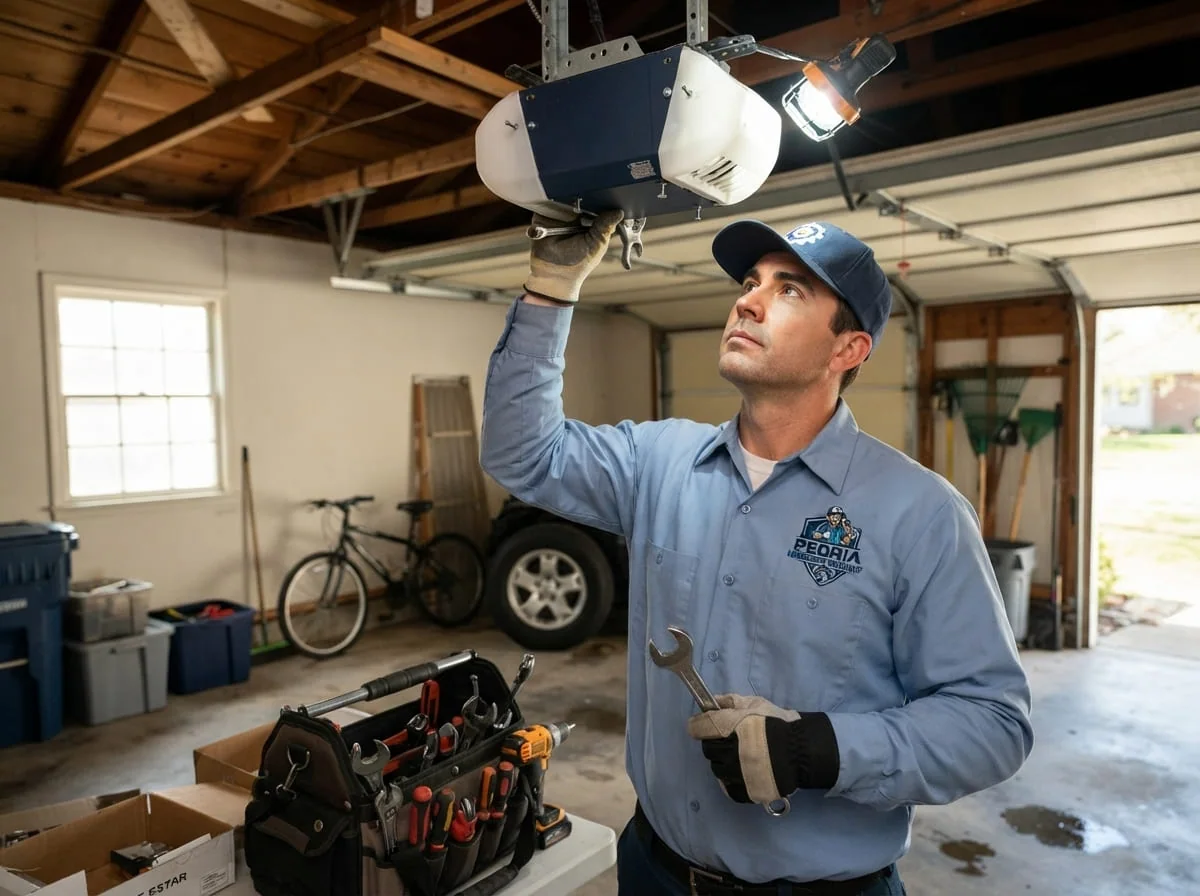
Every residential garage door opener built in the last three decades has a pair of small boxes mounted low on either side of the door track, usually four to six inches off the garage floor. Those are the safety sensors, sometimes called photo-eyes, and they're doing one job: shining an invisible infrared beam across the opening and watching for it to be broken. As long as the beam runs unbroken from one sensor to the other, the opener considers the doorway clear. Interrupt that beam with a trash can, a bike tire, a dog, or a kid's foot while the door is closing, and the opener is supposed to stop the door and reverse it back open before it makes contact.
This is a separate system from the mechanical force-sensing most openers also have, which reverses the door if it meets physical resistance while closing. Photo-eye sensors are meant to catch the problem before the door ever touches whatever's underneath it, which matters most for anything that can't take even a small amount of weight — a toddler, a pet, a bag of groceries balanced on a low shelf near the track. When we get a call about a door that 'just won't close' or one that closes a foot and reverses every single time with nothing visibly in the way, the sensors are the first thing we check, because they're the most common point of failure on the whole system and, thankfully, usually the easiest to fix.
Why These Sensors Exist: The CPSC History Behind Them
These sensors aren't a convenience feature manufacturers added for marketing — they exist because of a documented pattern of injuries and deaths, mostly involving young children, from garage doors that closed on someone with no way to stop or reverse the motion. Through the 1980s, the U.S. Consumer Product Safety Commission tracked a steady stream of entrapment incidents involving older openers that had no way to detect an obstruction at all; if the door met resistance, the motor just kept pushing.
That record is what pushed Underwriters Laboratories to rewrite UL 325, the safety standard that governs residential garage door operators, in the early 1990s. The revised standard required newly manufactured openers to include two independent entrapment-protection systems working together — typically the photo-eye pair described above and a mechanical force-reversal system — rather than relying on either one alone. Openers built before that requirement took effect can still be running in older Peoria homes today, particularly on West Bluff and Uplands properties where the original opener sometimes never got swapped out. If your opener doesn't have a photo-eye sensor pair at all, that's worth addressing regardless of how well the door otherwise runs, since it's the exact gap the standard was written to close. The U.S. Consumer Product Safety Commission still publishes safety guidance on garage door entrapment hazards, and it's worth a look if you want the full history of how we got the two-system standard we install to today.
Common Symptoms of a Sensor Problem
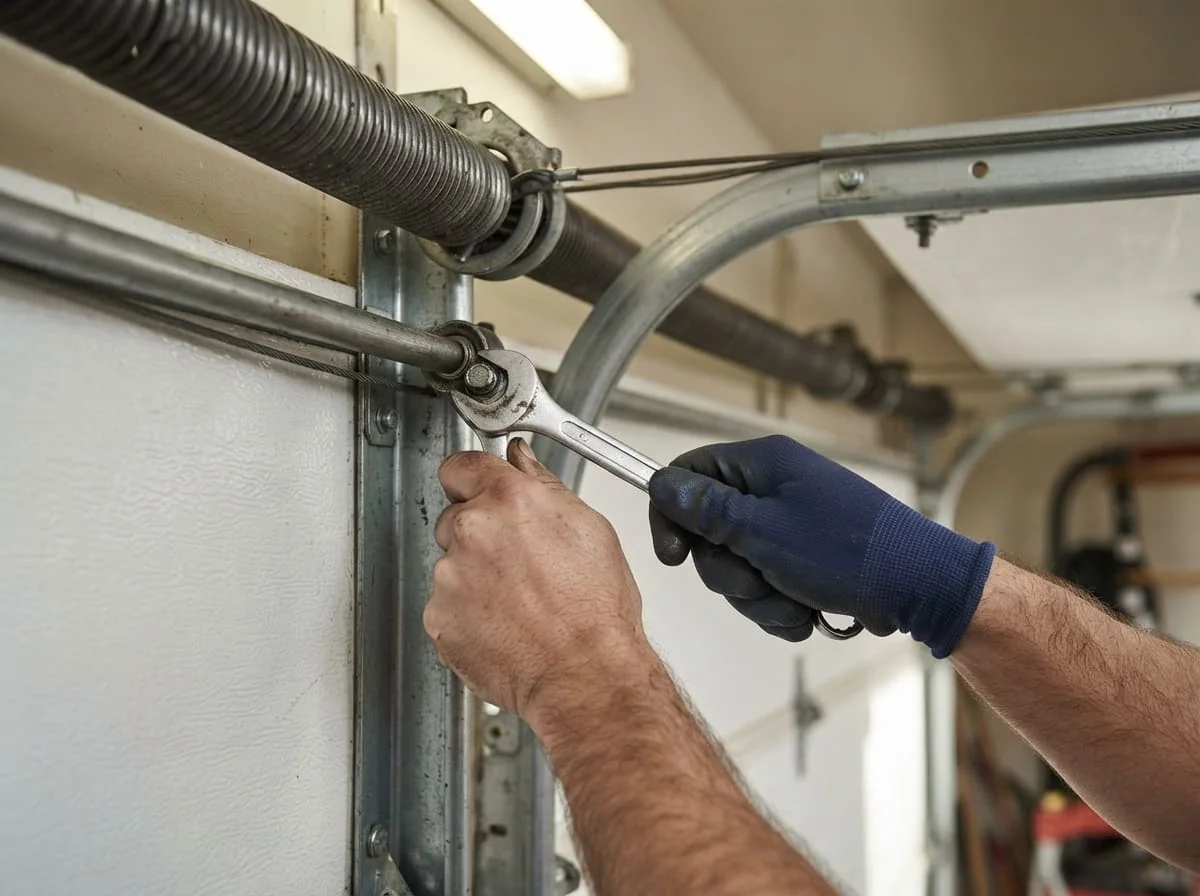
Sensor trouble tends to show up in a handful of recognizable patterns. Knowing which one you've got narrows down the fix before a technician even arrives.
| What you're seeing | Likely cause |
|---|---|
| Door won't close at all; opener hums or does nothing when you hold the button | Sensors misaligned, or beam blocked/broken continuously |
| Door starts closing, stops a few inches down, and reverses | Beam interrupted partway through the cycle — often glare, debris, or a marginal alignment |
| Door only closes when you hold the wall button down continuously | Opener has detected a sensor fault and dropped into manual-hold mode as a safety fallback |
| Problem comes and goes depending on time of day | Sun angle hitting the receiver sensor directly |
| Indicator light on one or both sensors is off, dim, or blinking rather than steady | Alignment, power, or wiring issue at that specific sensor |
Most openers have a small LED on each sensor housing that tells you the alignment state — solid usually means the beam is connecting, while off or blinking usually means it isn't. The exact light pattern varies by opener model and manufacturer, so check whatever manual came with your specific system rather than assuming one brand's convention applies to another. If you've lost the manual, the sensor housings themselves are worth a close look with a flashlight — sometimes the trouble is visible without any tools at all.
Step One: Check Alignment
Alignment is the single most common cause of sensor problems we run into, and it's the first thing worth checking before you assume something's actually broken. The two sensor brackets need to point directly at each other across the opening, and it doesn't take much to knock that off — a bump from a bike, a broom handle, a lawnmower, or even just years of the bracket's mounting screws working loose against the door frame.
What to check:
- Look at both sensor brackets from the side. They should be angled to face each other, not tilted up, down, or off to one side.
- Check that both brackets are still firmly attached — a bracket that's rotated even slightly on a loosened screw is a common, easy-to-miss cause.
- Confirm both sensors sit at roughly the same height off the floor. If one has drifted lower or higher than the other over time, the beam may be clipping the edge of the receiver instead of hitting it squarely.
- Gently straighten a bracket by hand if it's visibly off, then test the door through a full cycle before assuming it's fixed — a beam that's mostly aligned can still fail intermittently.
If straightening the brackets restores a steady light and the door starts closing normally, you're done. If the light stays off or blinking even after the brackets look square to each other, move on to the next step rather than continuing to force the alignment by hand.
Step Two: Clean the Lenses
Even a perfectly aligned sensor pair can fail if the lens itself is dirty, and this is a bigger issue in Peoria than in a lot of climates because of what gets tracked into a garage over a Central Illinois winter. Road salt and de-icing brine spray off tires and settle as a fine dust on every surface low to the garage floor, including sensor lenses that sit just four to six inches up. Add in ordinary cobwebs, lawn clipping dust in summer, and the general grime that accumulates on anything mounted near floor level, and a foggy lens is one of the most common — and most overlooked — sensor problems we find on service calls.
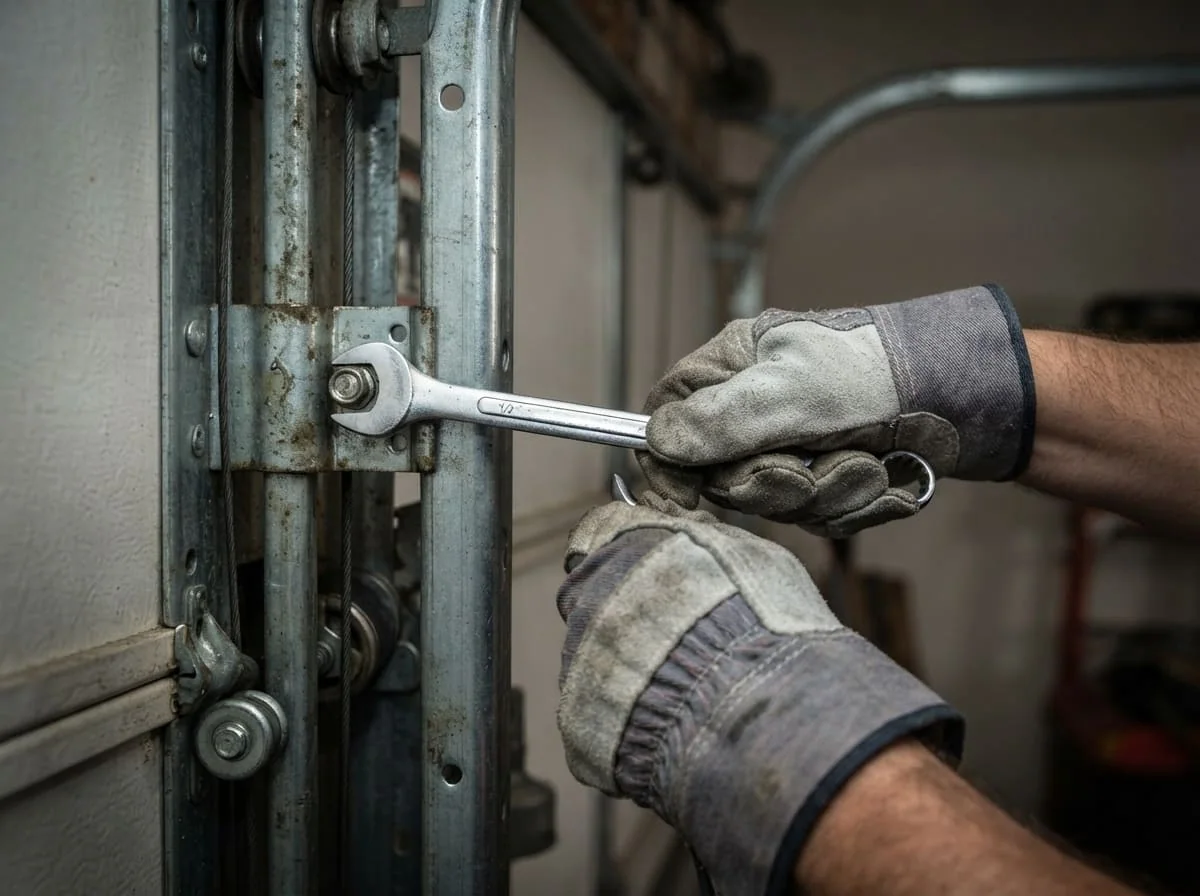
Wipe both lenses with a soft, dry cloth or a lightly dampened microfiber cloth; avoid anything abrasive that could scratch the lens coating. Do this on both sensors even if only one seems affected, since a partially fogged lens can still pass the beam most of the time and only fail under certain lighting conditions, which can make the real cause look intermittent when it's actually consistent. This is worth doing as routine maintenance a few times a year, not just when a problem shows up — it takes under a minute and heads off a surprising share of the calls we get.
Step Three: Rule Out Sun Glare and Light Interference
If the door works fine most of the day but consistently misbehaves at a specific time — often late afternoon in fall and winter — direct sunlight hitting the receiver sensor is a strong suspect. Central Illinois' winter sun sits at a much lower angle in the sky than summer sun, and a garage that faces east or west can end up with sunlight streaming almost straight through the door opening at certain hours, washing out the receiver's ability to distinguish the transmitter's actual infrared beam from ambient light. This is especially common on garages set at an angle to the street, which describes a fair number of the older homes around West Bluff and Uplands where the original garage placement didn't anticipate how opener sensors would eventually work.
A simple test: if the problem only happens at a certain time of day and resolves on its own an hour or two later, glare is very likely the cause rather than a wiring or hardware fault. A small shade, hood, or piece of angled cardboard temporarily taped above the affected sensor (never covering the lens itself) can confirm the diagnosis. If glare is confirmed as the culprit, a small permanent sun shield mounted over the sensor — many hardware stores carry simple clip-on versions — solves it for good without needing to replace anything.
Step Four: Inspect the Wiring
If alignment and cleaning don't resolve it, the wiring running from each sensor back to the opener unit is the next place to look. That wiring typically runs along the bottom of the door track and up the wall to the opener head, low enough to be vulnerable to a few specific problems: a staple driven in slightly too far and pinching through the insulation, a wire nicked by a lawnmower or edge trimmer stored nearby, corrosion at a splice from garage humidity, or — more often than homeowners expect — a chewed wire where mice or other small pests have gotten into the garage over winter.
Visually trace both wires from the sensor housing back toward the opener, looking for any spot where the insulation looks damaged, discolored, or where the wire has clearly been stapled through. A loose connection at either the sensor terminal or the opener's control board terminal is also a common, non-obvious cause, since it can pass current intermittently and produce exactly the kind of on-again-off-again symptom that's hardest to pin down without testing equipment. This is generally where we'd say it's worth having a technician take over — testing continuity and correctly reseating or replacing damaged sensor wiring is straightforward for someone who does it regularly, but it does involve working at the opener's control board, and we'd rather walk you through it or send someone out than have a repair attempt leave the safety system less reliable than it started.
How Peoria's Climate Wears on Sensors
Beyond the road salt dust already mentioned, Central Illinois' freeze-thaw cycle does its own slow damage to sensor reliability. Garage floor slabs and the concrete or wood framing sensor brackets are mounted to expand and contract across a Peoria winter's temperature swings, and that movement — repeated across dozens of freeze-thaw cycles each season — is enough to gradually shift a bracket's angle even without a direct bump. It's part of why a sensor pair that was perfectly aligned in October can be measurably off by February without anyone having touched it.
Humidity plays a role too. A garage that isn't heated or well-ventilated can see real condensation build-up on cold surfaces when warm, humid air moves through, and a sensor lens is exactly the kind of small cold surface that fogs first. If your door acts up specifically on humid mornings or right after a big temperature swing, condensation on the lens is worth checking before assuming anything's actually broken. None of this means sensors need constant attention — most systems run for years without an issue — but it's useful context for why a system that worked fine all summer can start acting up as the seasons turn, and why a seasonal check makes sense as part of general upkeep rather than something you only think about once it fails.
When to Stop Troubleshooting and Call a Technician
Alignment and cleaning fix the large majority of sensor complaints we hear about, and both are genuinely safe, reasonable things for a homeowner to check without any tools or experience. Where we'd draw the line is anything involving the wiring itself, the opener's control board, or a sensor housing that looks physically damaged or that won't hold alignment no matter how many times it's straightened — at that point you're likely dealing with a failed sensor unit, a bad connection at the board, or wiring damage that needs to be traced and repaired properly rather than patched around.
One thing we'd ask you never to do: don't disable or bypass the sensors just to get the door working again while you wait for a fix, even temporarily. It's technically possible on a lot of openers, and homeowners sometimes do it out of frustration when the door won't close and they need to leave the house. But the entire reason the two-system entrapment standard exists is that a single point of failure in this system is exactly the scenario that leads to a serious injury, and running a door with a known-bad safety system defeats the purpose of having one at all. If you've worked through alignment, cleaning, and glare and the problem is still there, that's the point to call in a technician rather than keep working around it.

Danny Kowalski
Owner and lead technician at Peoria Garage Door Repair Guys, serving Peoria, IL since 2015.
FAQs
Why won't my garage door close all the way?
This is almost always a safety sensor issue — either the beam between the two sensors is being blocked, the brackets have drifted out of alignment, or one of the lenses is dirty enough to interfere with the signal. Check both sensors' indicator lights first; if either one isn't steady, that's your starting point.
Can I bypass or disable my garage door safety sensors?
We'd strongly advise against it, even temporarily. The photo-eye sensors are one of two independent entrapment-protection systems required on residential openers precisely because a door with no way to detect what's under it has led to serious injuries in the past. If the door won't close because of a sensor fault, the fix is to repair the sensor, not to work around it.
How do I know if my sensors are just misaligned versus actually broken?
Start with the indicator lights and a visual check of both brackets. If straightening the brackets by hand restores a steady light and the door closes normally afterward, it was alignment. If the light stays off or blinking after the brackets look square and the lenses are clean, you're likely looking at a wiring or hardware issue that's worth having a technician diagnose.
Why does my garage door only act up at a certain time of day?
That pattern points strongly to sun glare rather than a hardware failure. Low winter sun angles common in Central Illinois can wash out a sensor's receiver at specific times of day, especially on garages facing east or west. A small shield mounted over the affected sensor usually resolves it.
How often should I check or clean my garage door sensors?
A quick wipe-down of both lenses a few times a year is reasonable, and it's worth adding to whatever seasonal maintenance routine you already run on the rest of the door. Peoria's road salt dust and freeze-thaw bracket movement make sensors a little more maintenance-relevant here than in milder climates.
My garage door opener is old and doesn't have sensors at all — is that a problem?
It's worth addressing. Openers manufactured before the early-1990s revision to UL 325, the industry safety standard, weren't required to include entrapment-protection sensors, and some of those units are still running in older Peoria homes. If yours doesn't have a photo-eye sensor pair, that's a real safety gap worth closing rather than a quirk of an older system.
Have a Garage Door Problem Right Now?
Skip the guesswork — call Peoria Garage Door Repair Guys for a fast, honest diagnosis.